Novelty Detection (Reference-Free / Open-Set)
TaxTriage's closed-set core scores organisms against the references you pull into the run (see TASS Scoring). But a sample almost always contains reads that align to no reference, either because the right genome was never in the panel or because the organism is too divergent to match one. The reads left over after alignment are called the residual, and the novelty branch characterises it. It tells you how much of the sample is unexplained and what taxa a reference-free translated search can still place, down to the genus-or-higher level.
This is exactly the situation in a limited-reference or mock run, for example when you align only against EBV genomes but the sample contains many other genera. The closed-set table will be nearly empty, but the novelty branch (backed by a broad database such as Kalamari) recovers the higher-rank signal.
Enable it by choosing a backend:
--novelty mmseqs2,--novelty kaiju, or--novelty bracken(defaultfalse= off). It never changes the TASS scores themselves; it is an additional, complementary view.
How It Works
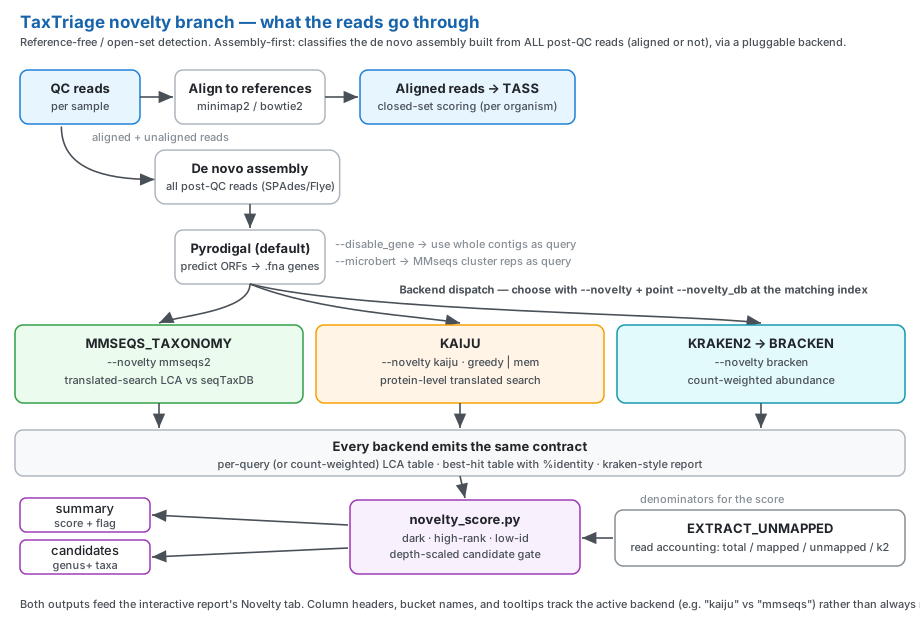
The branch is assembly-first with a pluggable backend (subworkflows/local/novelty.nf). It classifies the de novo assembly built from all post-QC reads, which is the same set of contigs handed to the annotation branch, rather than only the unmapped residual. This means the search can report organisms that did align to a pulled reference (e.g. targeted Ebola) alongside anything novel. By default a Pyrodigal ORF-prediction step runs first and the backends classify the predicted genes (see Gene mode); pass --disable_gene to classify the whole contigs directly instead.
- Account for the reads.
EXTRACT_UNMAPPEDcomputes the per-sample denominators the score needs: total, reference-aligned, reference-unaligned, and kraken2-classified counts. (It does not extract a read stream for taxonomy; the assembly is the query.) - Pick the query. By default Pyrodigal-predicted genes from the de novo contigs are the query. With
--disable_gene, the whole contigs are used instead. With--microbert, the shared MicrobeRT cluster representatives are used. Either way the query is nucleotide FASTA, so the same backends apply. - Classify with the chosen backend (see Backends below). Each backend emits the same contract: a per-query (or count-weighted) LCA table, an optional best-hit table with % identity, and a kraken-style report.
- Score and shortlist.
bin/novelty_score.pyturns the backend output into a per-sample summary (a novelty score, a flag, and a read-accounting breakdown) and a candidate list (the genus-or-higher taxa with enough support to report). It readsparams.noveltyto know whether the LCA carries a count column (bracken) or one row per query (kaiju / mmseqs2).
The collector bin/novelty_collect.py merges every sample's summary + candidates into report/all.novelty.json (plus per-sample JSON/XLSX), which the interactive report reads to build the Novelty tab. Throughout the report, column headers, bucket names, and tooltips track the active backend (e.g. "kaiju" vs "mmseqs") rather than always reading "MMseqs".
Backends
Choose with --novelty and point --novelty_db at the matching database. All three classify the de novo contigs:
--novelty | Tool & method | --novelty_db accepts | DB cache |
|---|---|---|---|
mmseqs2 | MMSEQS_TAXONOMY, a translated-search LCA (MMseqs extracts ORFs from the contigs internally). | MMseqs seqTaxDB name (e.g. Kalamari, UniProtKB) or a local seqTaxDB directory. | --novelty_db_cache (opt-in; default none) |
kaiju | KAIJU, a protein-level translated search (self-translates the contigs). Run mode is greedy or mem via --novelty_kaiju_mode. | A kaiju index alias (test, viruses/viral, nr, nr_euk, refseq, refseq_nr, refseq_ref, progenomes, fungi, plasmids, rvdb), an exact *.tgz, a URL, or a local dir. | --novelty_kaiju_db_cache (opt-in; default none) |
bracken | KRAKEN2_NOVELTY → BRACKEN, meaning kraken2 over the contigs, then bracken re-estimates count-weighted abundance. | A kraken2/bracken index alias (standard/standard_8gb/standard_16gb, viral, minusb, pluspf[_8gb\|_16gb], pluspfp[_8gb\|_16gb], core_nt, gtdb, eupathdb, ncbi_reference; k2_ prefix optional), an exact *.tar.gz, a URL, or a local dir. | --novelty_kraken2_db_cache (opt-in; default none) |
Aliases are auto-downloaded from the configured buckets (--novelty_kaiju_db_baseurl, --novelty_kraken2_db_baseurl). By default the download lands in the task work directory, exactly like the main --db, and nothing is cached across runs. Caching is opt-in: pass --db_cache_dir <base> (or a per-backend --novelty_*_db_cache) pointing at somewhere the executor can actually reach - a bucket prefix such as s3://my-bucket/dbs on cloud, a shared mount on a cluster, any folder locally. A genuine local checkout still uses <projectDir>/dbs/<backend> automatically.
Why the default is "no cache". An auto-derived cache path is a local POSIX path on the head node, which cloud workers cannot reach. On Seqera with Fusion it fails hard -
Unexpected path for Fusion script launcher: /nftass/scratch/.../dbs/kaiju/viral- which is why--novelty_db viralused to die where--dbnever did. A local cache path is also ignored automatically whenever the work directory is a bucket URI.
The kaiju test alias is a tiny git-LFS-hosted index for CI and -profile test; it always lives in work/ like any other test download. The bracken backend additionally honours --novelty_bracken_readlen (default 100, the kmer-distribution read length) and --novelty_bracken_level (default S = species).
Kaiju run mode (--novelty_kaiju_mode)
Kaiju can be run two ways, and the choice changes how divergent or conserved contigs resolve:
| Mode | Kaiju flags | Behaviour |
|---|---|---|
greedy (default) | -a greedy -e 5 | Allows up to 5 substitutions and picks a nearest-neighbour match even on divergent contigs. More sensitive, and better at placing genuinely novel sequence, at the cost of occasional over-reach. |
mem | -a mem | Exact maximum-exact-matches only (no -e). Avoids long conserved contigs collapsing to a coarse genus-level LCA on tied protein matches. More conservative/precise. |
If a run reports surprisingly coarse (genus-only) calls on contigs you expect to resolve to species, try --novelty_kaiju_mode mem; if novel contigs are going dark, greedy is the more sensitive choice.
Gene mode (default on)
By default Pyrodigal predicts ORFs on the contigs first and the predicted nucleotide CDS (.fna) become the per-query unit for every backend. One near-complete genome contig then contributes several LCA rows (one per gene) instead of one. That is closer to a per-gene BLAST view, and it suits the count-based novelty score better because it produces more, finer-grained counts. Pass --disable_gene to skip Pyrodigal and feed the whole contigs directly (one query per contig), trading granularity for a little less runtime. The summary TSV records which mode produced the row in its gene_mode column (1 = genes, the default; 0 = contigs), and the interactive report's Novelty tab labels its count unit accordingly: "genes"/"seqs" by default, "contigs"/"ctgs" under --disable_gene (and always "reads" for the bracken backend).
Negative controls are skipped by the novelty branch, because a flagged control is a process signal rather than a call about a sample.
VF/AMR for unaligned samples. When
--annotateis also set, samples that assembled contigs but aligned no reference now carry their VF/AMR annotation into the Summary and VF/AMR views (not just the Novelty tab). See Detection Rescue → Annotation of unaligned samples.
The novelty score
The summary score is a weighted sum of three z-scored signals (weights set by --novelty_weights, default 0.5,0.3,0.2):
| Signal | Meaning |
|---|---|
dark_fraction | Reads explained by nothing: not kraken2-classified, not reference-aligned, not MMseqs-placed. The core "unknown" mass. |
highrank_only_fraction | Reads MMseqs could place, but only at genus or higher (no species call). This is the hallmark of a divergent or missing-reference organism. |
lowident_tail_mass | Fraction of best hits below the amino-acid identity cutoff (--novelty_idnt_cut, default 50%). |
A sample is flagged when the score crosses --novelty_flag_z (default 2.0, i.e. ~2σ above the run baseline).
Candidate Taxa: the Depth-Scaled Threshold
A genus+ taxon is only listed as a candidate if its hit count clears a cutoff. Originally this was a fixed count of 10, which silently erased every candidate for shallow or long-read samples. In those samples the residual ORF counts are small, so even the strongest genus might hold only a handful of hits.
The cutoff now scales with the placeable-hit pool:
with min_reads = 2 (the top-level --novelty_min_reads) and min_cand_frac = 0.002 by default. The denominator is the number of genus+ (placeable) hits in that sample, not total reads, because candidate counts are in ORF/contig units rather than raw reads. Setting --novelty_min_reads 1 surfaces single-contig hits (useful for deep dilutions that assemble to ~1 viral contig) and also disables the depth-scaled cutoff entirely.
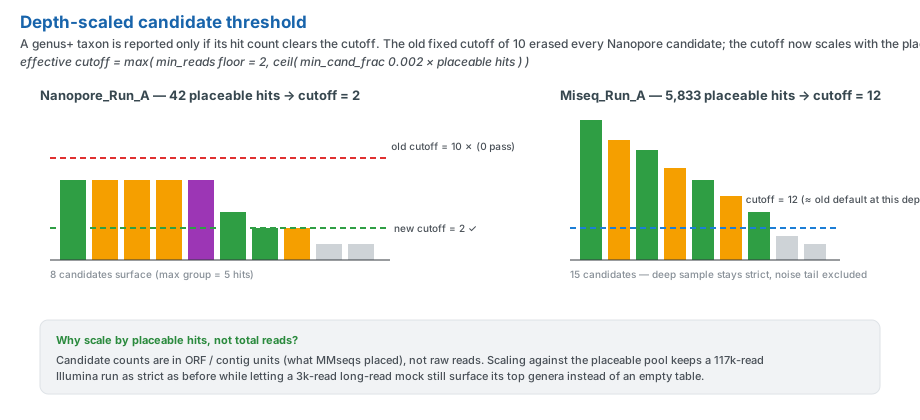
The effect: a deep 117k-read Illumina sample keeps an effective cutoff of ~12 (about the same strictness as the old default at that depth), while a 3k-read long-read mock, whose top genus holds only 5 ORFs, drops to a cutoff of 2 and shows its candidates instead of an empty table.
Long reads are not the cause of an empty candidate table. Low residual depth is. A small ONT/PacBio sample and a small Illumina sample behave identically here; what matters is how many ORFs the residual produced.
Each candidate row carries:
| Column | Meaning |
|---|---|
reads | Hit count at this taxon (ORF/contig units). |
frac_of_sample | Share of total sample reads (small for ORF-level counting; kept for continuity). |
frac_of_highrank | Share of all placeable genus+ hits. This is the honest "how dominant is this genus among what MMseqs placed" number that the comparison views key on. |
Domain vs. superkingdom
NCBI's 2024 taxonomy renamed the top rank superkingdom → domain. The scorer counts both, so domain-level placements (e.g. Bacteria) are no longer dropped from the candidate list or from highrank_only_fraction.
The Novelty Tab in the Interactive Report
The Interactive Report gains a Novelty tab (visible whenever --novelty produced data) with three linked views.
1. Per-sample novelty summary
One row per sample with the score, the flag, and inline bars for dark_fraction, highrank_only_fraction, and the identity tail. Flagged samples are highlighted.
2. Method coverage: "where every read landed"
A per-sample stacked bar that accounts for the whole sample across five disjoint buckets that sum to 100%:
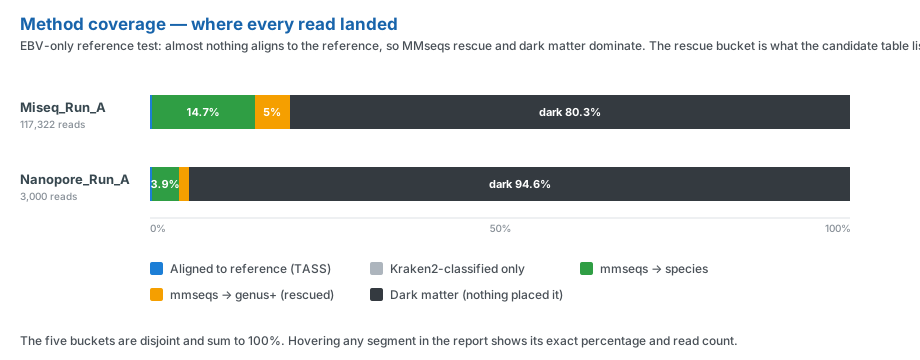
| Bucket | Colour | Meaning |
|---|---|---|
| Aligned to reference (TASS) | blue | Reads that mapped to a pulled reference. This is the closed-set TASS basis. |
| Kraken2-classified only | grey | Classified by kraken2 but not aligned and not MMseqs-placed (known taxon, no reference in the run). |
| MMseqs → species | green | Residual reads/ORFs placed at species-or-finer. |
| MMseqs → genus+ (rescued) | orange | Residual placed only above species. This is the rescue bucket the candidate table lists. |
| Dark matter | near-black | Explained by nothing. |
This is the direct answer to "what fraction was hit by alignment/TASS vs. what was rescued by MMseqs vs. what stayed dark." All samples render together so you can compare, e.g., an Illumina run against a Nanopore run side by side. Hover any segment for its exact percentage and read count.
3. Genus: TASS vs MMseqs
A genus-by-genus cross-check joining the closed-set TASS rollup with the MMseqs placements for the selected sample:
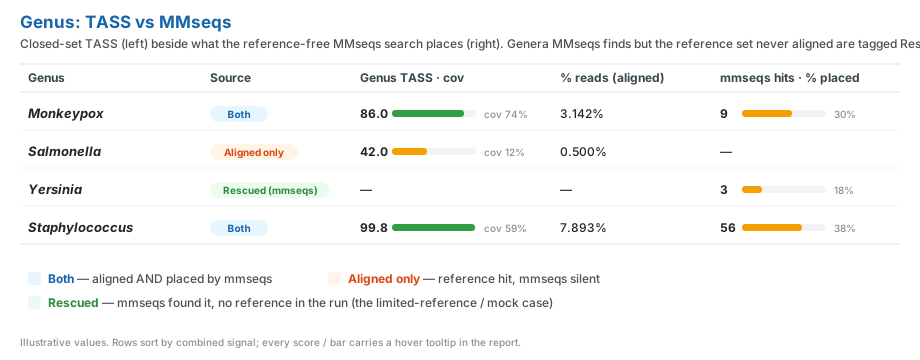
Each genus is tagged by where the evidence comes from:
- Both: aligned to a reference and placed by MMseqs.
- Aligned only: a reference hit, but MMseqs placed nothing there.
- Rescued (mmseqs): MMseqs found it but the reference set never aligned it. This is the limited-reference / mock case made explicit: e.g. Monkeypox at TASS 86 with 74% coverage on the left, versus its MMseqs placement share on the right.
Sparkbars and hover tooltips appear throughout. A toggle in the tab switches between Method coverage and Genus: TASS vs MMseqs.
Interpreting the Outputs
Whichever backend you pick, scoring is identical, so the artifacts read the same way. The two per-sample TSVs are the source of truth; the report just visualises them.
novelty/<sample>.novelty.summary.tsv: one row per sample
| Column | How to read it |
|---|---|
sample | Sample id. |
classifier | Backend that produced the row (mmseqs2, kaiju, or bracken). Report headers and tooltips track this name. |
gene_mode | 1 = Pyrodigal predicted-gene queries (the default), 0 = whole contigs were classified (--disable_gene). |
total_reads | Denominator for every fraction below. |
dark_fraction | Share of reads explained by nothing (not aligned, not kraken2-classified, not placed). High → genuine dark matter / missing reference. |
highrank_only_fraction | Share the backend could place, but only at genus or higher. The hallmark of a divergent or absent-reference organism. |
lowident_tail_mass | Share of best hits below --novelty_idnt_cut. High → weak, distant protein matches. |
z_dark, z_highrank, z_lowident | Each raw signal as a z-score against the run baseline. |
novelty_score | Weighted sum of the three z-scores (--novelty_weights). |
novelty_flag | 1 when novelty_score ≥ --novelty_flag_z (default 2.0). |
ref_aligned, k2_classified, mmseqs_assigned | Read/contig counts behind the method-coverage buckets. mmseqs_assigned is the backend's total placed count regardless of which tool ran. |
mmseqs_assigned_species, mmseqs_assigned_highrank | Of the placed count, how many resolved to species vs. genus+ only. |
ref_aligned_frac, k2_frac, mmseqs_frac | The same as fractions of total_reads. |
A useful first read: a high novelty_flag with a high highrank_only_fraction and a populated candidate table = a real organism the reference panel missed. A high flag driven mostly by dark_fraction with an empty candidate table = unplaceable dark matter, or simply too little residual depth (see Troubleshooting).
novelty/<sample>.novelty.candidates.tsv: the genus+ shortlist
The taxa that cleared the candidate gate, each carrying reads (hit count in ORF/contig units), frac_of_sample, and frac_of_highrank (share of all placeable genus+ hits, which is the column the comparison views key on). For kaiju and mmseqs2 a "read" here is one contig/gene query; for bracken it is a bracken-estimated read count. Counts are small by nature (a residual rarely assembles many contigs), so judge dominance by frac_of_highrank, not raw reads.
Backend differences worth knowing.
mmseqs2reports an amino-acidpidentper best hit, solowident_tail_massand--novelty_idnt_cutare most meaningful there.kaijuemits one LCA row per query (no count column); its resolution depends on--novelty_kaiju_mode.brackencarries a real count column and re-estimates abundance, so its candidate counts are read-weighted rather than one-per-contig.
Downloads
The Novelty tab links the raw artifacts, all written to report/:
| File | Contents |
|---|---|
all.novelty.json | Combined feed (all samples) the report is built from. |
all.novelty.xlsx | Combined workbook: Summary + Candidates sheets. |
<sample>.novelty.json / .xlsx | Per-sample summary + candidates. |
novelty/<sample>.novelty.summary.tsv | Per-sample score + read-accounting columns. |
novelty/<sample>.novelty.candidates.tsv | Per-sample genus+ candidate taxa. |
Parameters
See CLI Parameters → Novelty Detection for the full table. The essentials:
| Parameter | Default | Purpose |
|---|---|---|
--novelty | false | Master switch and backend selector: mmseqs2, kaiju, or bracken. |
--disable_gene | false | Skip the default Pyrodigal step and classify the whole contigs instead of predicted genes. See Gene mode. |
--novelty_db | Kalamari | Database for the chosen backend, given as a name/alias (auto-downloaded) or a local path. See the Backends table for what each accepts. |
--novelty_db_cache | unset | Opt-in storeDir cache for the mmseqs2 download. |
--novelty_kaiju_db_cache | unset | Opt-in storeDir cache for the kaiju download. |
--novelty_kraken2_db_cache | unset | Opt-in storeDir cache for the bracken/kraken2 download. |
--novelty_kaiju_db_baseurl | kaiju S3 bucket | Index bucket kaiju aliases are fetched from. |
--novelty_kraken2_db_baseurl | genome-idx S3 bucket | Index bucket kraken2/bracken aliases are fetched from. |
--novelty_kaiju_mode | greedy | Kaiju run mode: greedy (sensitive) or mem (precise). See Kaiju run mode. |
--use_denovo | false | Build the de novo assembly the novelty branch classifies. |
--novelty_weights | 0.5,0.3,0.2 | w_dark,w_rank,w_idnt for the novelty score. |
--novelty_flag_z | 2.0 | Score threshold for flagging a sample. |
--novelty_idnt_cut | 50.0 | Amino-acid % identity below which a hit counts toward the low-identity tail (mmseqs2 pident). |
--novelty_min_reads | 2 | Candidate floor: min hits to report a taxon (contigs for kaiju/mmseqs2, reads for bracken). 1 disables the depth-scaled cutoff. |
--novelty_bracken_readlen | 100 | bracken -r read length (kmer distribution to use). |
--novelty_bracken_level | S | bracken -l rank level (S = species). |
The lower bound of the candidate gate is the top-level --novelty_min_reads (passed straight through by the NOVELTY_SCORE module). The depth-scaling fraction (--min-cand-frac, default 0.002) is a novelty_score.py default and is not exposed as a pipeline flag; the module forces it to 0 (disabling depth scaling) whenever --novelty_min_reads ≤ 1. To use a different fraction, edit the module/script. For very shallow residuals, prefer --novelty_min_reads 1.
Example
This mirrors the EBV novelty run: align only against EBV, classify the contigs with kaiju, and annotate.
nextflow run main.nf -profile test,docker -resume \
  --input ebv/1/temp_samplesheet.csv \
  --db /path/to/k2_pluspfp_08gb \
  --outdir ebv/1/ttoutput \
  --remove_taxids '9606 3052458' \
  --organisms '3052462 3052460 186538' \
  --max_memory 12GB \
  --skip_kraken2 \
  --novelty kaiju \
  --novelty_db ~/databases/kaiju/kaiju_db_viruses_2024-08-15 \
  --use_denovo \
  --annotate
Aligning only against EBV means the closed-set table is sparse, while the novelty branch recovers the higher-rank genera present in the sample. This is exactly the scenario the Method-coverage and Genus comparison views were designed to make legible. Swap --novelty kaiju for mmseqs2 or bracken (with a matching --novelty_db) to change backend.
Troubleshooting
A sample is flagged as novel but its candidate table is empty. It is below the depth where any genus clears the candidate cutoff. Confirm by checking novelty/<sample>/<sample>.novelty_lca.tsv: if it has genus+ rows but the candidate TSV is header-only, the residual is simply too shallow. The depth-scaled cutoff mitigates this; for very small residuals you can lower --min-cand-frac / --min-reads via the module args.
The Novelty tab is blank on click. The report draws each tab lazily. If you ever see an empty pane, hard-refresh the page (Cmd/Ctrl+Shift+R), because file:// pages can cache an older copy. Any genuine render error now prints a red message in the pane rather than leaving it silently empty.
See also: Interactive Report · TASS Scoring · Output · CLI Parameters